
Article
How Smart Video Analytics Reduces False Alarms
False alarms waste time and erode trust. Smart video analytics security filters noise so Laval property teams in Chomedey, Fabreville, and Sainte-Dorothée can focus on events that actually need attention.
Quick Summary
- Smart video analytics security classifies people, vehicles, and other objects so routine motion does not flood phones for Laval teams.
- Parking lots, loading docks, and street-facing cameras in Chomedey and Fabreville often gain the most from tighter object-based alerts.
- Quebec snow glare, wind, and seasonal lighting shifts make basic motion detection especially noisy on outdoor Laval cameras.
Why trust this article
Written by: Pro Vision Security Team (Montreal Security Specialists)
Reviewed by: Pro Vision Security Technical Team (Local Technical Review)
Updated on:
smart video analytics security: the short answer
For smart video analytics security, the right solution connects your property's real risks, your building's quirks, and a clear plan for what happens when something goes wrong. In Montreal, an on-site visit confirms coverage, cabling, who gets access to what, and the support you'll get, before the final price is set.
There is no single perfect number of devices that works for everyone. A smaller but more complex property can need more planning than a large open space. Compare quotes based on real results and total cost, not just the starting price.
What causes most false camera alarms in Laval?
Most false camera alarms come from wind-blown trees, headlights, insects, shadows, snow swirl, and busy sidewalks near sensitive zones.
Basic motion detection treats almost any pixel change as important. That creates alert fatigue, especially on outdoor cameras facing parking lots or arterial roads common across Chomedey and Fabreville.
In Laval winters and rainy shoulder seasons, weather and lighting shifts make this worse. Without smarter filtering, staff start ignoring notifications—exactly when a real after-hours event needs attention.
If your wider camera plan still needs work, start with placement basics in /en/blog/security-camera-installation-montreal and /en/blog/security-cameras-montreal-guide, then layer analytics where noise is highest.
How does smart video analytics filter noise?
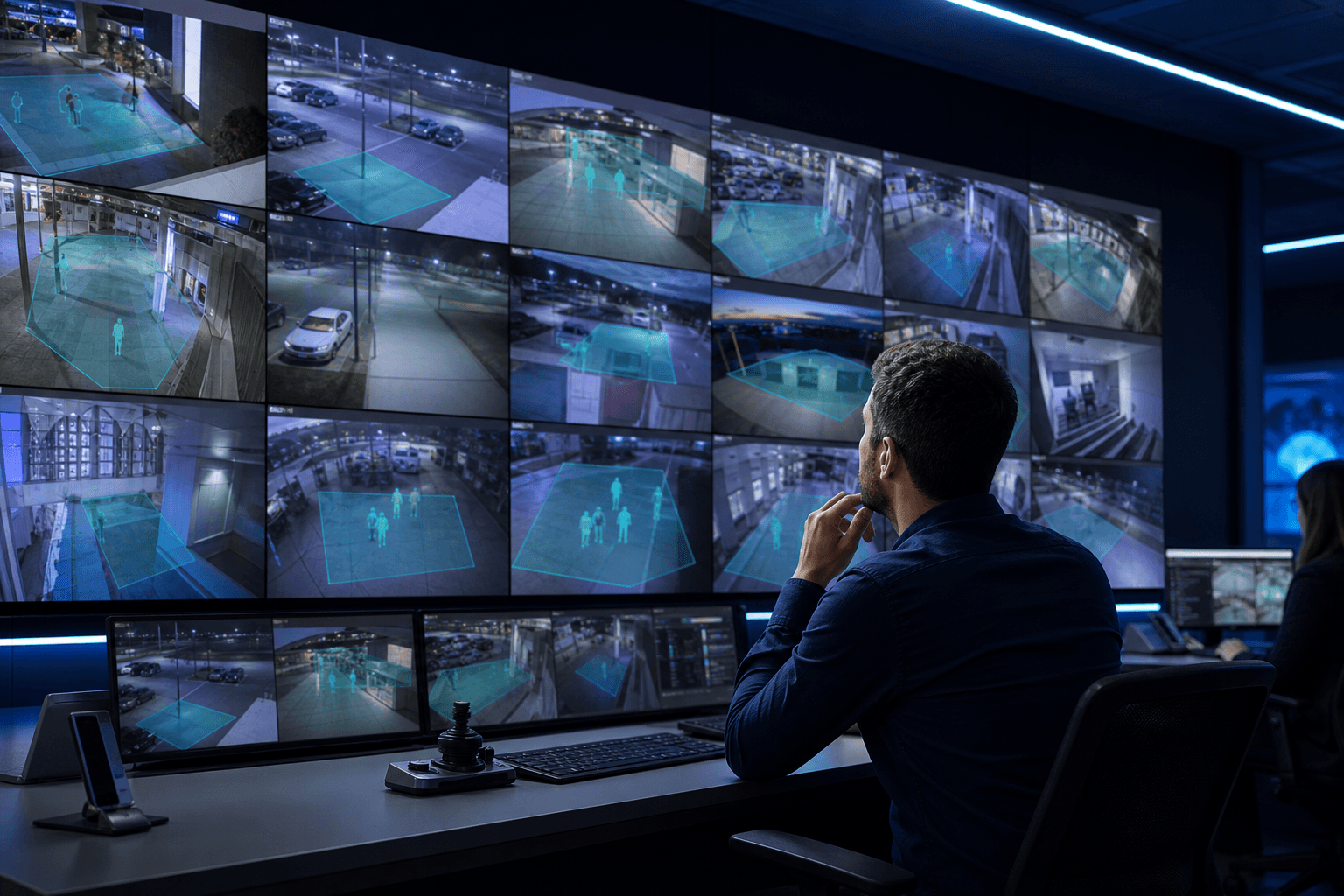
Smart video analytics looks for meaningful objects and behaviours instead of every visual change on the screen.
Rules can prioritize people entering a restricted area, vehicles stopping at a loading door, or loitering near an entrance after hours. Routine background motion can be ignored or logged without a push alert.
Our smart video analytics service on /en/services/smart-video-analytics is designed to make alerts actionable, so you spend less time checking empty parking lots and more time reviewing real events across Laval sites.
Where should Laval businesses apply analytics first?
Start with cameras that generate the most noise: parking lots, rear lanes, storefronts, and docks.
These zones usually have legitimate daytime activity and quieter overnight periods. Analytics can use schedules so daytime motion is treated differently from after-hours intrusion risk—useful for Sainte-Dorothée industrial yards and Chomedey retail plazas alike.
Laval warehouses near major corridors and multi-bay commercial buildings often share the same pattern: high daytime traffic and a need for quieter nights. Fix the noisiest cameras first so your team feels the benefit quickly.
Cross-check whether alert fatigue is also a monitoring-process issue by reading /en/blog/monitoring-response-workflows-designed-first and our article on 24/7 escalation workflows.
Do you need new cameras to use analytics?
Not always. Some analytics run on newer cameras, edge devices, or a compatible recorder and software layer.
An assessment checks whether your current cameras have enough resolution, angle, and lighting for reliable object detection. Poor mounting, heavy backlight from snow glare, or cameras aimed too wide across a Fabreville lot can limit results even with good software.
Sometimes repositioning a camera or improving night lighting delivers more value than replacing every unit at once. That keeps investment focused on the zones that actually drive false alarms.
How do analytics help monitoring and response?
Cleaner alerts help operators and managers verify events faster and escalate with better context.
When video verification is available, analytics can surface the clip most likely to show a person or vehicle. That reduces time spent scrubbing through irrelevant motion after a late-night signal.
Fewer nuisance alarms also protect relationships with staff and neighbours who otherwise grow numb to constant notifications. For how monitoring and verification fit together, see /en/blog/24-7-monitoring-workflows and /en/services/monitoring-24-7 when you compare service options.
How do Laval climate and building types affect tuning?
Snow banks that change height, wet asphalt reflections, and long winter nights all change what outdoor cameras “see” from month to month.
Commercial plazas with wide parking fields, light industrial docks, and mixed residential-commercial edges in Sainte-Dorothée each need different zone shapes. A schedule that matches real opening hours prevents daytime customers from looking like overnight threats.
After major storms or seasonal leaf changes, re-check outdoor cameras that suddenly start alerting more often. Small tuning visits prevent alert fatigue from returning just when teams are busiest.
What setup habits keep false alarms low?
Keep detection zones tight, exclude busy public sidewalks when possible, and review alert logs monthly.
Update schedules when store hours change. Retrain staff not to leave doors propped open in camera-covered areas if that triggers policies you care about.
Also review how cameras connect to alarms and doors so the whole stack stays coherent—/en/blog/security-stack-weak-points-incident-prevention is a practical checklist for that review.
You can visit our Saint-Laurent office on Google Maps at https://www.google.com/maps/search/?api=1&query=5929%20Trans%20Canada%20Route%2C%20Suite%20240%2C%20Saint-Laurent%2C%20Quebec%20H4T%201Z6 to discuss which Laval cameras should get analytics first.
How do you know analytics is working?
Track alert volume, the share of alerts that were real, and how quickly someone confirms an event.
A successful setup usually shows fewer total notifications with a higher percentage of useful ones. You should also find relevant clips faster during investigations after an incident at a Chomedey or Fabreville site.
Ask for a before-and-after review on your noisiest cameras so you can see whether tuning actually changed day-to-day workload—not just whether new software was installed.
What should Montreal weather and buildings mean for your plan?
A security project in Montreal has to deal with more than just the size of your property. Freezing winters, snow, road salt, humid summers, and big temperature swings can affect outdoor cameras, cables, door hardware, and Wi-Fi reliability. Equipment that works fine in a sheltered lobby downtown may not hold up on an exposed loading dock in Saint-Laurent or an outdoor entrance in Laval.
The type of building matters too. Older homes and buildings in areas like Notre-Dame-de-Grace or Villeray can have finished brick or stone walls and limited paths for cables. Warehouses near the Trans-Canada highway often need longer cable runs and a clear plan for who responds after hours. A good assessment looks at all of this before any equipment is quoted.
How does Pro Vision Security look at your property?
We start by asking what you actually need: recognize a face, confirm an alarm, control who can open a door, or quickly find a past event. Then we walk your property, check lighting and foot traffic, note any areas that need privacy, confirm your internet and power, and figure out who should be contacted during and after business hours.
You should end up with a clear, written plan that connects every camera, sensor, and door to a reason. It should cover coverage areas, who can access what, how long footage is kept, how you get notified, training, and room to grow later. This avoids a common mistake: buying equipment first and only later figuring out how it should actually be used day to day.
What should you ask before comparing quotes?
Ask each company what is included in the price, what could make the price change, and how their plan handles your biggest concern. Confirm whether cabling, permits (where needed), setup, training, activating monitoring, warranties, and support afterward are included. A low price on equipment can hide bigger costs later for setup and service.
Also ask how you will find footage, add or remove someone's access, test your alarms, and get help outside business hours. Ask for a demonstration using a real example from your property. A good provider should be able to explain, in plain language, exactly what happens when something goes wrong, and how easy the system will be to manage as your needs change.
How should privacy and cybersecurity be handled in Quebec?
Your security system can include video of people, records of who came and went, names, phone numbers, and notes about past incidents. As a Quebec home or business owner, you should know why each piece of information is collected, who can see it, how long it is kept, and what happens if there is a request or an incident. Cameras should avoid pointing at private areas that do not need to be covered.
Use separate logins for each person, extra login protection where available, remove access right away when someone leaves, and make sure remote access is secure. This matters most for apps and cloud dashboards you can check from your phone. Rules around privacy and insurance can vary, so it is worth checking with a qualified advisor rather than assuming the equipment settings alone are enough.
What happens during installation and hand-off?
A proper installation includes testing, not just mounting cameras and running wires. The team should check camera views and sensors both day and night, confirm the time stamps on events, test a priority alert, confirm your contact list is correct, and make sure everyone who needs access can actually use the system. Anything that does not work as expected should be fixed before the job is considered done.
You should also get simple training, basic documentation, warranty details, and an easy testing schedule. You need to know how to add or remove a user, find a past event, report a problem, and reach support. A quick check-in after the first few weeks helps fix any annoying false alarms or gaps that only show up once you are actually using the system.
How do you keep your system working well over time?
Review your system after renovations, staff changes, new hours, repeated false alarms, or anything that showed a gap in your coverage. At least twice a year, check that your devices are working, your cameras are clean, your doors close properly, your contact list is current, and you can still easily find footage. Outdoor equipment deserves extra attention after a Montreal winter.
Pay attention to what actually matters, not just the number of devices you have. Useful things to track include how long it takes to confirm an alert, how often you get false alarms, failed attempts to get in, and how long it takes to find footage. These tell you whether your system is really helping you make faster, safer decisions.
Frequently asked questions
Is smart video analytics the same as recording everything?
No. Recording stores footage. Smart video analytics security decides which events deserve an alert so people do not review endless motion.
Will analytics stop every false alarm on a Laval property?
It greatly reduces common causes, but lighting, mounting, and zone design still matter. Expect fewer, better alerts rather than perfection.
Can analytics work outdoors in Laval winters?
Yes, when cameras are rated for the environment and aimed correctly. Seasonal retuning after snow and glare changes helps keep performance steady.
Does this replace professional monitoring?
No. Analytics improves what gets flagged. Monitoring still provides after-hours response when your Chomedey or Fabreville team is unavailable.
Which Laval businesses see the fastest improvement?
Sites with outdoor cameras near traffic, parking, trees, or loading docks usually notice the biggest drop in nuisance alerts.
How long does setup and tuning take?
Initial setup can be relatively quick, then a short observation period helps refine zones and schedules for your property.
Should Sainte-Dorothée warehouses prioritize docks or parking first?
Usually start with the camera that generates the most ignored alerts—often docks or lot edges—then expand once the team trusts the quieter notifications.
Can analytics help with alarm verification too?
Yes. Cleaner person and vehicle detection supports faster video verification when an alarm zone trips after hours.
Which areas do you serve around Montreal?
Pro Vision Security serves Montreal, Saint-Laurent, Laval, the West Island, and nearby communities, depending on the project.
When is an on-site visit worth it?
A visit is worthwhile whenever your cabling, lighting, doors, internet, or daily routine could change the design or the price.
Conclusion and next step
If false alerts are wearing down your Laval team, smart video analytics security can make camera systems useful again. Ask Pro Vision Security for a quote on analytics for Chomedey, Fabreville, Sainte-Dorothée, or elsewhere in Laval—and we will map which cameras and zones should filter noise first via /en/services/smart-video-analytics.